
I’ve Never Been to Pure//Accelerate
And That’s Probably Why I Listen So Carefully to the People Who Have

There is a certain irony in writing about a conference you’ve never attended.
Every year when Pure//Accelerate rolls around, I see the photos — the bright orange glow, the Vegas skyline, the stage lighting, the inevitable “great conversations!” LinkedIn posts. And every year I’m somewhere else entirely. I’m helping my team with reviewing a cyber recovery design, attending a partner QBR dissecting pipeline gaps, or in a budget planning session explaining why AI initiatives without proper infrastructure architecture are simply expensive science experiments.
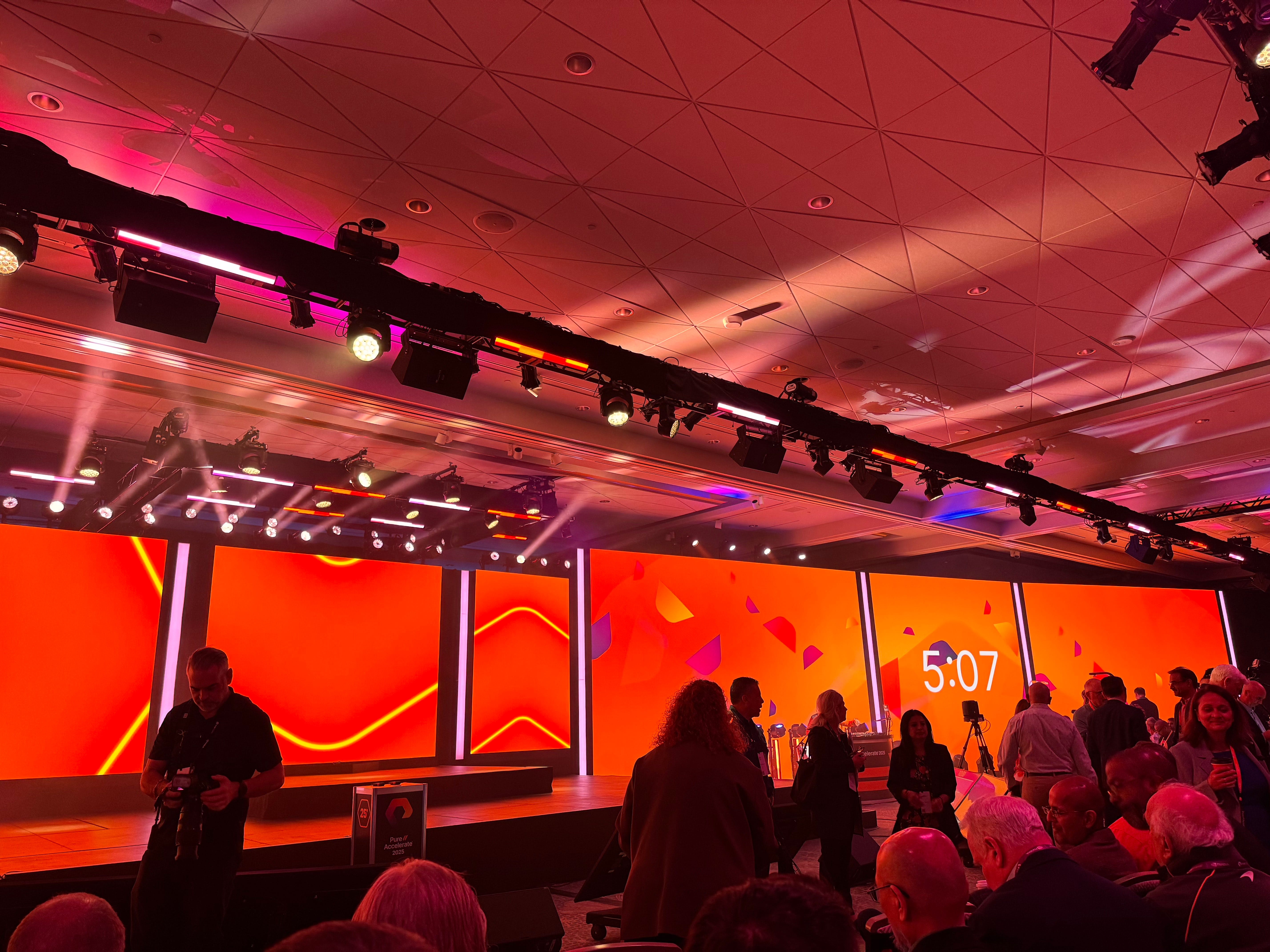
So no — I haven’t walked the expo floor. I haven’t scanned a badge. I haven’t sat in the keynote ballroom.
But I’ve had something else.
I’ve had dozens of conversations with the people who did.
And over the last five years, what I’ve heard from customers, value partners, alliance partners, and even prospects has been consistent enough that it stopped sounding like marketing and started sounding like signal.
The Conference Landscape We All Pretend to Love
Let’s be honest about our industry events.
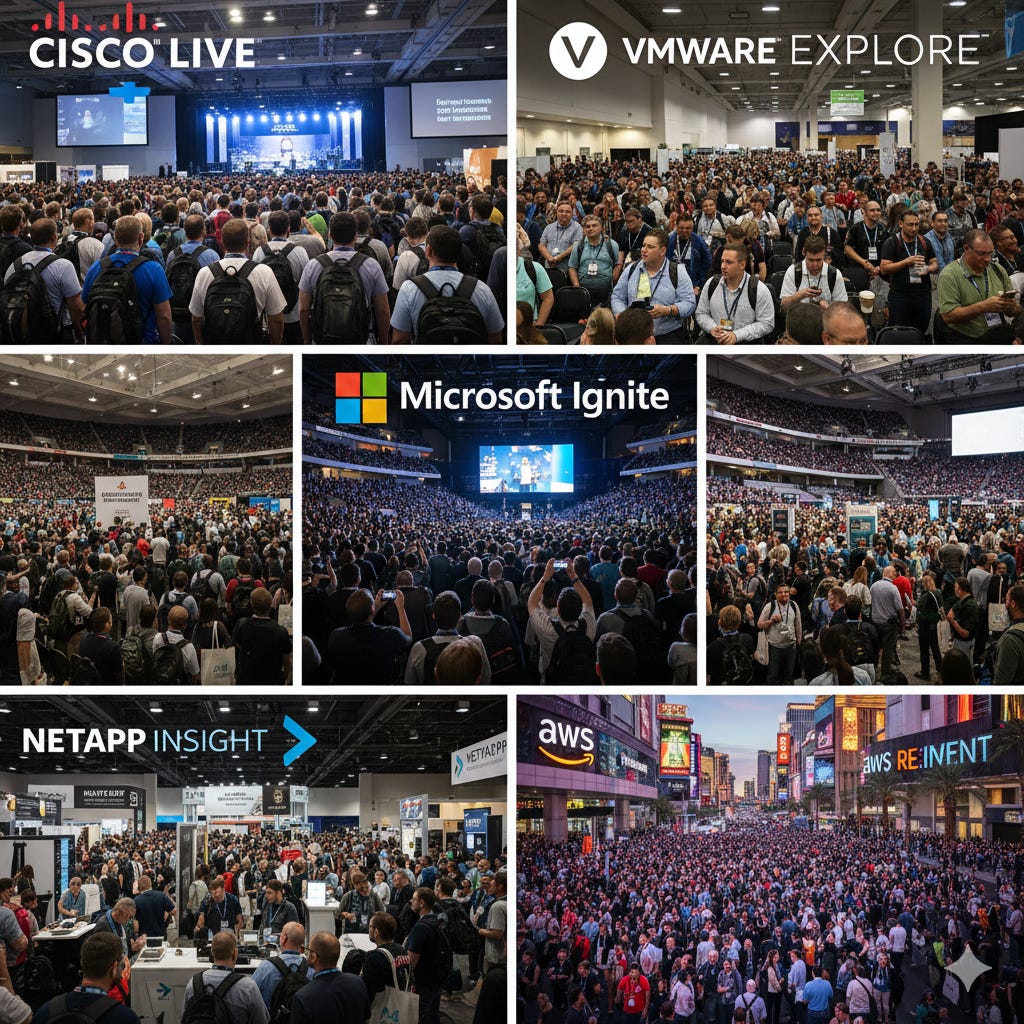
Some are massive. So massive that you need a logistics strategy just to move between halls. They are impressive, energetic, and occasionally overwhelming. You return with a backpack full of branded water bottles and a vague sense that something important happened — though you’re not entirely sure what.
Others are smaller and more technical, deeply focused but sometimes so narrow that they feel disconnected from the broader ecosystem reality we all operate in.
Pure //Accelerate seems to sit in a very deliberate middle ground. Over the past several years, attendance has ranged from thousands in hybrid formats to roughly a thousand-plus in-person participants — large enough to create ecosystem gravity, yet intimate enough for real conversations to occur without shouting over a DJ.
That balance matters more than most people realize.
Because value at a conference doesn’t come from the size of the stage. It comes from the quality of the conversations that happen off it.
What Prospects Actually Go There For
When prospects attend an event like //Accelerate, they are not looking for inspiration. They are looking for certainty.
One CIO I work with told me after returning, “It wasn’t about seeing new features. It was about validating our direction.” That distinction stuck with me.
Large infrastructure decisions are not made lightly. Platform shifts impact teams, budgets, careers, and in some cases reputations. Prospects attend Accelerate to reduce uncertainty. They want to meet product leadership in person, to ask hard architectural questions without time constraints, to hear unfiltered stories from existing customers who have already made the leap.
What they gain is not excitement — it is clarity.
And clarity shortens decision cycles.
Deals don’t accelerate because of slides. They accelerate because doubts get resolved in real time.
The Part Most Conferences Don’t Deliver
There’s another theme I’ve heard repeatedly — and this one matters more than the stage production or the product announcements.
Access. Not symbolic access. Not “wave at the keynote speaker from Row 47” access.
Real access. Partners and prospects told me they sat down with product managers and walked through roadmap questions in detail. They had direct conversations with engineering leaders about architectural constraints and integration realities. They challenged assumptions. They asked uncomfortable questions about feature timelines, scalability limits, and operational tradeoffs.
And they weren’t brushed off. They were listened to. That distinction is enormous.
In most large vendor conferences, executives are visible but not reachable. Product managers are presenting, not engaging. Engineering teams are somewhere behind the curtain. Pure Storage founder still works full time - how awesome is that?

At //Accelerate, the feedback I keep hearing is different. The leadership team is present. The product managers are approachable. The engineering experts are available for whiteboard conversations. And perhaps most importantly — they respond.
I’ve heard stories of:
Feature feedback acknowledged on the spot
Roadmap clarifications that changed deployment decisions
Integration concerns addressed with real technical depth
Escalations redirected directly to accountable leaders
For partners, that kind of access accelerates confidence (pun intended, of course). For prospects, it reduces risk. For alliance partners, it validates seriousness.
When you can look someone in the eye and ask, “Is this roadmap real?” — and get a detailed, technically grounded answer — that changes the tone of a relationship.
It turns vendor interaction into collaboration.
And collaboration turns into long-term business.
The Reselling Partner Lens
For reselling partners, the lens is different. The question isn’t, “Should we buy?” It’s, “Where should we invest?”
Partners operate in a world of limited bandwidth and competing vendor priorities. They need to know which platforms deserve engineering time, which ecosystems are gaining momentum, and where services opportunities are forming.
From what I’ve observed through partner debriefs, //Accelerate consistently provides roadmap visibility that translates into strategic confidence. When partners hear about platform unification, operational simplification, AI-ready architectures, and lifecycle economics — and see those themes reinforced across sessions, demos, and customer stories — it gives them something powerful: narrative coherence.
And narrative coherence becomes pipeline.
Customers don’t buy part numbers. They buy solutions to problems. If a partner can leave an event with a clearer, more defensible story about how a platform reduces operational friction or prepares for AI without architectural chaos, that story becomes a sales asset.
I’ve seen partners return and immediately refine their service offerings. Not because they were dazzled, but because they were aligned.
Alliance Partners and Ecosystem Reality
Then there are alliance partners — virtualization vendors, AI framework providers, security platforms, cloud adjacencies, networking and backup solutions.
They don’t attend to admire branding. They attend to assess ecosystem durability.
Is this integration deep or superficial?
Is there co-engineering or just co-marketing?
Are roadmaps aligned or merely adjacent?
//Accelerate appears to be a proving ground for these questions. Joint demos, integrated workflows, and shared customer stories are signals of maturity. For alliance partners, that maturity determines how much joint go-to-market energy they are willing to commit.
Ecosystems are fragile if they are built on slideware. They are durable if they are built on technical interoperability and shared direction.
From what I’ve heard, the event reinforces the latter.
The Tone That Keeps Coming Up
Across the feedback I’ve collected over the past five years, one theme repeats: operational reality.
Not speculative hype. Not buzzword theater.
Operational reality.
Conversations around simplifying management planes. Around cyber resilience that actually recovers workloads. Around sustainability measured in power, space, and refresh cycles. Around AI readiness framed not as magic, but as data architecture discipline.
That tone resonates across audiences because it addresses what keeps leaders up at night.
Prospects want fewer unknowns.
Partners want repeatable services.
Alliances want stable integration paths.
Operational reality serves all three.
Why I Believe the Event Works
If I had to summarize why Pure//Accelerate appears to generate genuine return attendees, it would be this:
It focuses on platform coherence.
In a world where infrastructure stacks are increasingly fragmented — multiple clouds, virtualization shifts, container platforms, cyber tooling, AI pipelines — coherence is rare. When an event centers on unifying data operations and reducing complexity instead of multiplying components, it offers something practical.
That practicality translates into action after the event.
I’ve seen opportunities progress because executive objections were addressed face-to-face. I’ve seen partners refine positioning based on clearer roadmap insight. I’ve seen prospects move from evaluation to commitment because ambiguity was removed.
That’s not the result of a light show. That’s the result of access and alignment.
The Part Where I Admit It Again
I still haven’t been.
Every year I tell myself I’ll make it work. And every year something else pulls me back into the field — into customer strategy sessions, architecture reviews, or partner planning workshops.
But perhaps there is value in observing from the outside. Because what I’m measuring isn’t the production quality of the keynote. It’s the after-effect.
And the after-effect is consistent.
Customers request to return. Partners plan around it. Alliances invest deeper.
In our industry, repeat attendance is the truest form of feedback.
Maybe this year I’ll finally collect my orange badge.
Until then, I’ll keep listening to the people who did — and watching what happens after they come home.
That’s where the real value shows up.
The registration is now open for this year’s event Register Now. If you can go, do it.
Dmitry Gorbatov
© 2025 Dmitry Gorbatov | #dmitrywashere